
Jukebox Rotation for War Days

this morning the ocean is flung out across the sheets, flagrant and languid, 
beads of light on its skin, the street is slow and lazy, air thick and heavy after rain, 
sliding its thighs together for the sheer pleasure of their weight, hibiscus unfurling, 
batting their lashes, licking their lips like they’re sleepily eating something with honey, 
bees drowse and bumble, still a little drunk from last night’s debauch, 
none of them are picturing the poet 

who told me years ago about the day 
he understood that songs were poetry, he lay 
on his best friend’s bedroom floor in brooklyn, 
now he is lying on the floor of my head 
with the rest of history

scattered in snapshots, sometimes polaroids, sometimes salt prints, 
albumen calotype ambrotype tintype daguerreotype cyanotype 
gelatin silver it depends on the period, the history of the world 
according to high school dropout, useless archive 
of partial things, the poet 

was sixteen. the album had just come out. the song 
was 7 O’Clock News / Silent Night.
he and his best friend lay side by side 
on the floor of the bedroom in brooklyn 
in vietnam wave after wave of u.s. troops broke 
and broke over the nation they destroyed by the time i was born 
the poet was a professor and i was told 

to look vets on the streets in the eye when i stepped over their legs, 
don’t be afraid my father said, say excuse me, give them change if you have it
he gave me change so i would have it it doesn’t matter what they do 
with it, they won’t hurt you he said they’ve done all the hurting they ever 
meant to do and then some, this fucking
country my father said this fucking country and its fucking 
walking dead remember

being sixteen when the radio 
mattered, and the car and the car’s tinny radio 
countdown, the weight of the keys, the power 
of pressing the gas, of gathering speed, the mastery 
of steering, rush of shifting gears, the girl 
with red hair, her hand out the window, her cigarette, the wind 
blew strands of hair across her face it always got
stuck in her wet n’ wild lipgloss, i hooked my finger 
to pull it free of her mouth i always smelled like her

apple drugstore shampoo we sang along to billy joel she would pretend to 
sing i would pretend not to notice when her voice would fade out she’d listen 
to me catch the low low notes she couldn’t hit 
alone 
once
her lips against my ear, breath quick, she whispered sing
to me, i like the way the low notes feel 
inside so i sang 
into her ribs i sang
into the cleft of thigh i sang 
it didn’t even matter what i sang 
today

the ocean is flung out across the sheets, lifting her body offering herself 
to the flagrant sun, beads of light on her skin i can barely remember 
the latin declensions or the types of greek columns or the names 
of cloud formations until late at night when i least
need them

but the smashed vase of history 
is scattered in pieces all over the floor of my 
head and every day i walk barefoot across
crouching to fish out stray bits
of what might matter 
the poet who did not want to go to war 
the vet on the sidewalk who said thank you young man
solemnly to me when i handed him 
the nickel i’d been holding in my fist 
and i nodded solemnly in return
i wonder

if they played taps at his 
funeral, if someone was there
to play taps if someone was there
to take the folded flag 
the archive

of every song i’ve ever 
sung into someone’s 
broken body so it would 
hum with the low 
low notes they couldn’t hit
alone
Keloid

It was an eyesore, the scar, a small lumpy tumescence above my friend’s left eyebrow, like an overgrown pimple. It was ugly. If he could’ve he would’ve hidden it, but his hair stuck straight up from his forehead like a wiry brush reaching for the clouds. So he tried to hide his entire self instead. Sitting at his desk he’d tuck his long limbs toward his body, knees to chest and calves clutched in tight, as though he were trying to pull himself shut. And he never spoke. At the beginning of the day, when the teacher called his name, he put his hand up wordlessly, raising it over his face so that it concealed not just his forehead, but most of his features, disappearing even as he admitted that he was, yes, here.

The boys in our class—a terror of eight-year-olds, myself among them—followed him during recess, goading him to speak. What is that? we’d say, pointing at his forehead. Is it a bug bite? A volcano? He’d cover the scar and look away, saying nothing.

The following spring he began to mete out single words, then sentences. He spoke an accented and scholarly English. He and I, the two fastest runners on the football pitch, became friends. He was always over at my house. His aunt worked late and my parents were happy to have him around: Such a polite and quiet boy; he could teach you a thing or two.

One afternoon we were sitting on the old blue duvet, eating fried potatoes wrapped in paper saturated with so much grease it was translucent. I was talking about my epileptic cousin, who I had recently witnessed having a seizure. He nearly died, I said dramatically, although it wasn’t exactly true.

My friend touched his scar and said, Ah, me as well. Then he began to tell the story. 

In the country where he’d grown up, my friend explained, his father had served as the Minister of Wildlife and Game. It was a minor role but carried responsibility and prestige. My friend was proud to be the Minister’s son. Then the coup happened. The new regime made a list of every person who served in the old cabinet, and not just them, but their spouses, their children, their parents. Soldiers ambushed my friend’s mother and brothers on their way to school. But my friend wasn’t with them. He was home with a fever. Home with his father. A soldier found them there. 

The first shot missed, my friend said. The second hit here. The third went into my father’s brain.

The fried potatoes had grown cold. Outside someone was kicking a ball into a wall in a hollow pulselike rhythm.

Then my questions came bursting out. How could people let this happen? Why didn’t the police stop it? Why didn’t they vote the old regime out and put them in jail?

Patiently, my friend explained: others would’ve been killed if they had protected my friend and his family. The police, the court, and the judges belonged to the new government. And there were no more elections.

Finally I burst out, But that can’t happen!

It can’t, he said, but it did. Now there is nothing else to be done.

That shocked me into silence, his resignation: There is nothing else to be done.

I don’t know whether we ever talked about it again. Certainly it changed my view of my friend. The way he curled into himself seemed less like a girding and more like an attempt to contain the horror safely inside. I wondered how a person survived that. We remained friends until we were teenagers, when he went to a different sixth form. But even as time moved us further from one another, the thing he’d said came back to me again and again: There is nothing else to be done. It gnawed at me when I received my exam results and realized that because of several low marks, I wouldn’t be able to attend university. When I got a stultifying job at the local council: There is nothing else to be done. And when I was made redundant: nothing else. A few years ago, when cancer bloomed in my wife, caught too late for treatment, the words became a comfort. I thought then I understood what my friend had meant. My wife wasted away and really, there was nothing else to be done.

Recently someone I knew from school sent me a news article. At first I didn’t understand why. It was one of those things that seems to happen all the time now, though you don’t like to think about it: a young man with a machete attacked a children’s music recital. Five children and two adults were injured before one of the fathers disarmed the attacker. I had to read the article twice to understand that the hero of this story was my old friend.

A video was embedded. In it, my friend was older, with parentheses on either side of his mouth, his hair receding as though to emphasize the keloid on his brow, which had neither shrunken nor softened as he’d aged.

A towheaded reporter tilted a microphone toward him and asked him if he had been afraid.

Everyone is afraid with a weapon pointed at them.

The reporter was unsatisfied. People are calling you a hero. How did you know what to do?

My friend raised his hand, then lowered it, like he was waving away or thought, or had reached to touch his scar but thought better of it.

No one knows what to do, he said. My child was in danger. Her friends. And we are all already dead too soon. So that man could not be allowed to keep his weapon. There was nothing else to be done.

Caddis

n. a worm; a weave

Green, olive, pale butter, cream, the soft-bodied grub in its portable case
Cases are tubular, collaged of debris, fastened by silk spun from the larval mouth
Mouth of the Great Lake blowing the last ice flats downriver
Rivers, riffles, lakes, streams, seeps, ponds, creeks—the architect builds its room in fresh waters
Water in December, cold and clean, a glittering guest at the front door
Door through which the head emerges: bristled, biting mouthparts, light & motion-sensing eyes
Eye of the rainbow sees panoramic caddis-snow—casemaker, collector, scraper, swimmer—adrift
Drifting through the midlayer on silken parachutes, out of Gondwana, across time
Time of peak drift, the sliver before dusk
Timespan of case construction, a day
Timeline of transfiguration, a year
Lifetime of fly, an anorectic moon
Moontime, the architect collects, in its grapple-hooked prolegs: sand, shell, stone, twig, bark, leaf,
____ cellulose-based rayon, polyester, acrylonitrile-butadiene-styrene, polyacrylamide, vinyl ester
____ resin, polyvinyl chloride, thermoplastic polyurethane, polypropylene, polyethylene
Polyethylene plastic nurdles, one billion pounds a year, manufactured by Nova Chemical
Nova Chemical says their plastics make everyday life healthier for people on the St. Clair River
Rivers are prime sinks for marine microplastics
Microplastics wander my blood, my brain, my heart, my lungs, my liver, my kidneys
Microplastics colour my breastmilk, my eyes, my throat, my ovaries, my saliva, my urine
Microplastics are in the zooplankton, zebra mussels, moths, mosquitoes, mayflies, in gobies, perch,
____ pickerel, in bass, bloater, bluegill, in pumpkinseed, catfish, whitefish, in
In the developing world, says Nova Chemical, the thirst for plastics is off the charts
Charting Lake Huron by distribution, type, and abundance of plastic debris per beach
Beaches at Sarnia yield ninety-four percent of total polyethylene nurdles across all sites sampled
Samples over a decade show plastics in nine-tenths of all Great Lakes drinking water
Great Lakes drinking water should be clean and cold
Cold December moon, Manidoo-giziisoons, Little Spirit Moon, the soft-bodied grub in its
____ microplastic case
Cases are swallowed whole, with their soft-bodied spirits, by glittering trout with panoramic eyes
I am pretty pleased, says the mayor, industry is the real hero here
Here in Sarnia, come springtime, caddisfly lift from the river like mist at dawn

Shine Early, Spring Salmon

My father and I pulled weeds today—
mouse-ear chickweed. Highly invasive.
European, of course.

In the forest, on walks, we target
cheat grass. Another invasive import.

This all started recently, this fixation
on invasive plants. It all started because
my mom wants native wildflowers
in the front of their house.

I’m trying to make this into
a metaphor, but it’s so literal:
the invaders are at the gate.

We walk through the forest
and I try to read it like a book.
I imagine I have the eyes of my Karuk ancestors,
eyes that could tell friend from foe
on the forest floor
with a glance.

What sicknesses would they notice
in the patterns of the moss?

Thousands of generations
spent
learning
________tending
___________befriending
our quiet kin.

Two generations
_____________to forget.

It is June, and I am sad
that pakachakaachas—
the Stellar’s Jays—
are gone. Tâat,
Kach’Aka, Píshiip and Axak left
two days ago from their drain pipe
nest, and my heart is filling their
void
______with
___________flowers.

At one time, Karuk speakers had accents thick enough that
they could tell where folks grew up by their
diphthongs and twangs. This fact makes me more
sad than many others that also make me
sad.

___________________________________We will never know the sum of what we’ve lost.

But the dams, at last, are broken.
The salmon swim again.
One hundred years,
One hundred
___________generations
Yet still they remember the way.

Karuk stories end
with this phrase
“Shine early, Spring Salmon, hurry upriver.
My back is straight.”

April is called iruravahívkuusra.
Spring Salmon month.

_______________________________________________The invaders are at the gates.

One hundred years ago
the Klamath dams were built
to be permanent.
But it was not the dams that
stood the test of time.

How long can this year go on?
I ask the salmon,
looking at the
destruction
____________invasion
_______________________conflagration
around the planet.

One year, she replies mildly.
Then it’s done.

Countdown

10… 

“When you look down at Earth, what do you think you’ll see?” 

Planetary departure is inevitable. There’s nothing left here for her to do. Mandatory isolation is T-minus three days. The dishes reside as permanent tenants in the stainless steel sink—water rations. Seeds from last year’s harvest, pocketed away in small business card-sized envelopes. 

Some for Harry to take, and the rest to stay with me, tucked away in a waterproof bag.

“Layers and layers of blue, and you. I think I’ll always be able to see you.” 

Her fingers dance alongside the back of my hand, past the scar from the time I tried to remove the pit from an avocado. A long-ago fruit. A long-ago scar. 

She’ll still be here, but not really.

9…

“Do you have to go up there?”

Stevie Nicks sings about time casting a spell on both of us from a spinning vinyl in the den. Harry cocoons herself against my back, wrapping her thin arms around my hollow stomach and up between my breasts. It’s too hot to lie like this, but we do it anyway. 

“The Ruby-crowned Kinglet and the Nashville Warbler—”

“Gone?” 

Harry nods her forehead into the nape of my neck, loosening my thinning braid. I want to tell her we can do more, convince the neighbors to turn their lights off at night, compost, but I know better. 

She says, “Without the birds…” 

Between her and me, it’s the things left unspoken that make me understand her the most. I hope Stevie is right and that she won’t forget me. 

Without the birds, the crickets won’t chirp.

The petrichor will be but a faint memory.

8…

“It’s about the tilt, then?”

Harry mouths delicate words—morrowlight, aurorae, lustrate—into my chest. Natural oil ran out long ago, but it doesn’t stop her from drilling straight through the core of my heart. 

“During Spring Equinox, the sun crosses the celestial equator, and the Earth’s axis doesn’t tilt away or toward the sun.”

The reflection of my eyes in hers is a tiny dwarf planet, expansive and deep. I’m reclassified like Pluto, no longer clearing her orbit.

Glow-in-the-dark stars constellate the ceiling of our bedroom into heart-shaped glaciers and ice. 

A forgotten planet is on everyone’s lips.

7…

“Would it be so different? ”

Harry paces the rug at the foot of our bed like an invisible spacehook is tugging her back. I spent last night buzzing her wavy shoulder-length hair down with a number two guard. 

“Gene expression changes in space, but they’re changing here, now. You can see that, can’t you?” 

I think about the phantom tether between me and my mother and my grandmother, how our lives begin and end in a hypoxic state. With Harry, the air continues to evaporate.

With the window open, nothing moves through. 

6…

“Do you remember our first date?”

There’s a Polaroid of us on the fridge. 

I stand at the portable camp stove, poking at what should be Harry’s favorite meal—Pho. But it’s mainly broth for her to eat one last time. Protein pills sound like such a drag.

“You named all the planets from biggest to smallest in less than ten seconds.”

I’d never met a real astronaut before. 

“JupiterSaturnUranusNeptuneEarthVenusMarsandMercury.” 

The planet’s names whistle through the gap in my teeth. A party trick, maybe, but two pieces of metal in space will collide eventually, only to fuse with the other.

Pale, yellow garlic scapes lay on the cutting board. Overflowered. 

But the bees don’t come.

5…

“Did you ever love me?”

Harry stops packing her 3.3 lbs of personal items. Everything that matters is right here in this house, on this land, even if it’s not thriving, too big for a bag. 

“I won’t spend our last days together proving what you already know to be true.”

She steps into my space and pulls the shirt off my body. A threadbare old cotton thing from a Pride run we did together at the beginning of our relationship. She rolls it with precision, tucking it into a sealed Ziploc bag, next to her other personal preference items.

I think of all the flowers I’ll never get to smell again if she doesn’t go now.

April hasn’t been the same since the lilacs stopped blooming. 

4…

“How much time do we have left?”

This existence is intolerable. I used to count the days, weeks, and months we’d been together until the years were a blurred mess of always.

“An eternity if we’re lucky. The rest of our lives if we’re smart.”

But we’ve done all the smart things, reduced our carbon footprint. Washed on cold. Went vegan. Showered together. 

What a waste.

A day on Earth is almost a year on Venus. Twin sisters. Fraternal but not identical. 

3…

“And if you don’t come back?”

Warm droplets pelt our skin, and what a relief to know, March’s rain wasn’t the last we’d ever feel.

“Do you feel that? The world wants to soften, to grow again.”

Forehead to forehead, she peppers her lips across my cheeks, nose, and mouth. 

Rain on a wedding day is a good omen. 

But what about on liftoff?

2…

“If it all goes dark?”

A Harvest Moon casts an orange glow on an inky sky. But she has her seeds, and I have mine.

“Stars twinkle. Don’t forget to romanticize the darkness, too.”

Phosphenes bloom behind closed eyes. 

Flashes of light, sparks, and color. 

1…

“What’s left to say?”

That we haven’t already said to one another.

Some things have disappeared over time, like the chamomile lawn Harry grew and the good coffee.

“We’re on a parallel countdown, you and I.”

Desperation lingers, along with the impression of her on the mattress. I wait for the tilt—for the sunbeams to scatter light across the room again before I break the earth with the spade. 

But for now it’s only darkness.

We’re an Ark split in two.

Slumber party

She taught me the words for my body and then stripped them away, all my anatomy, my life-giving, my floating head tied down by a thin ribbon and a small but dense weight, made me just like her, disoriented, umbric and amniotic, just a silly game, a wet smooch, aren’t you too young to think about boys, this is what my daddy and mommy do, this is called the, your, my, my, my, oh my, too obedient to say God, filling with dark confetti, small but dense, that slumber-party scent, rape-sweet with shame, purple sparkles suspended in gooey shame, cello-dark like dozens of doll eyes, desire suspended in context, my who has known molestation but still wants, my mislabeled Wednesday, my belly button, my cold seat, I who know but still want, I who just like her, I who think about boys, I who say God like a small but dense weight, I who life-giving feel shame, I who dark desire give in to the cello, no word for body, all slumber

Body Count

in the beginning, there were numbers.
a mouthful of them invented to make murder 
sound too much like arithmetic: 
one body, plus one scream, times 2,000. 
count. 2,000 seconds from now, 
the sky will fall a little lower. 
you won’t feel it, but that’s the 
whole point. every second is leash
to hold. pull long enough, & something 
gives—a brick, a breath, a body. 
2,000 meters away, abuja area mama 
is murdered. her jaw clenched shut
like she bit through 2,000 spoons, 
because the knife was busy elsewhere 
in her body. at the crime scene, a man
says she saw it coming. says war begins 
at 2,000 miles before the first shot is fired.
says a number first fits into a mouth, 
long before it fits into a headline: 

news flash—popular nigerian trans woman
found dead along abuja highway. tragic incident. 

say mister, then say ma’am. 
say incident as if violence is a thing 
that stumbles into itself. 
as if a blade trips, & suddenly 
there’s a throat in the way. 
you count 2,000 ways to burn 
& not one of them requires fire. 
i count 2,000 kilometers spreading too wide 
for justice. 2,000 steps taken
from the scene to the morgue.
2,000 failures stacked 
into something that moves—or will 
no longer move. 
i have seen a man’s face break 
when he steps over a body
that looks like his but isn’t. 
i have grazed concrete that bore
the outline of a scream, the contour of a jaw 
that resisted. what have we made 
of this world? you count numbers, 
i count cities by how fast they eat 
their dead. 
somewhere, someone prays for morning 
& gets only more night. 
safety is a watered dialogue 
budding in the mouths of norm-borns.
the rest of us lock our doors & pray our pronouns 
don’t leak into the night.
at 2,000 feet above sea level, the air thins, 
but not my memory. 
2,000 lights have gone out & each one, 
a little apocalypse. 
i will count. i will count 2,000 times 
if that’s what it takes. 
if that’s what it takes 
for one of them
to finally count 
back.
count. 
Hilary Ikechukwu Emerole.

count.
Hamza Idris-Tofawa. 

count.
Umar Yusuf-Dungurawa.

count.

[If You Have Received This Notice]

If you have received this notice,
______________________________________you ________________” will no longer be valid.
Additionally, please note ____________________no _________grace period
________________________________________you ________________will be invalid immediately

What do you need to do?


____________________________________surrender
____________________Upon surrendering _____________________you will be issued a new
_____gender ____________________consistent
_____________________________________compliant

Can you appeal this notice?


________________________________no


We apologize for the inconvenience this causes you.

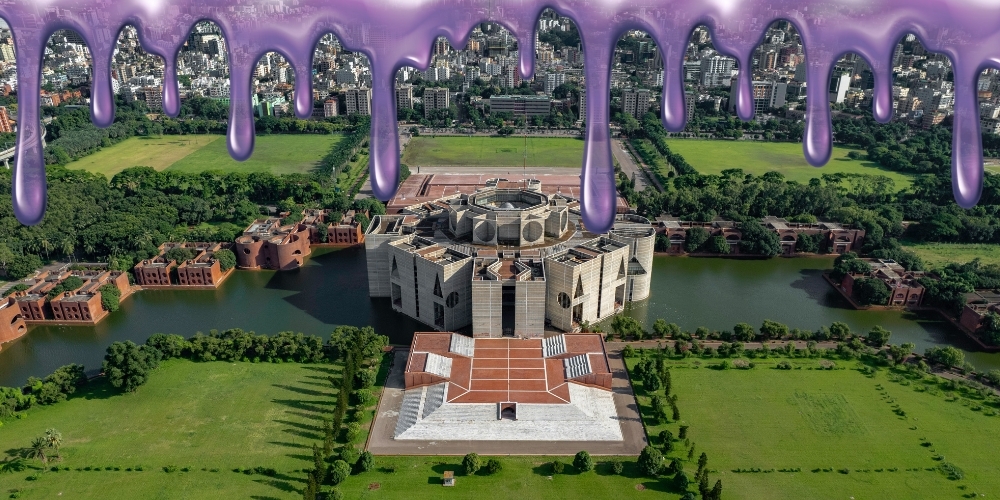
Louis Kahn’s Ghost: National Assembly Building, Dhaka, Bangladesh

1961, construction began———the Architect drawing a dream———in poured concrete. A substantial challenge———to give lodging to Democracy———to give form to the State when she is still forming———coagulating from Partition and Injustice———nebulous, indeterminate. 1971, the people demanded Revolution———Independence and Liberation, lofty ideals———petrified Architect granted Absolution by his own demise. 3000 Moons later———completed posthumously———they say his ghost haunts the Rotunda———whispers to Members of Parliament———Spirit & Science———Spirit & Science———Spirit & Science—conjecturing whether he got it right———the precise Configuration of Arches to Atriums———Courts to Porticoes———Aperture to Volume. It’s true———he had not envisioned the serene lake as Moat———the heftas Fortress———the Machine Gun Military Men patrolling its walls———the questionable use of that teal carpet———let alone, the Dictator———to whom his specter gesticulates wildly———something about civic duty———having lost his voice.

New Nukes and Old Ghosts

I did not know until my husband’s feet turned blue, until the tumors conquered his lungs and thwarted his breath, until the morphine drip stilled, and the feeding tube dangled empty of nutrition. Only when no warm place remained to rest my face, to seek his aliveness, only then did I learn that Michael’s father died at 58 of the same aggressive lung cancer. 

Only then did I also learn that Dick, his journalist father, witnessed the dawn of the nuclear age. My mother-in-law Katie, the loss of her 36-year-old son merging with her widow’s grief, her white hair neat in its daily braided bun, cast her eyes on her lap, her hands twisting the thinned gold wedding band. She spoke without raising her gaze.

They were handed goggles but no other protection. They were told to turn around. 

My father-in-law, dead long before he would have become my father-in-law, returned from WWII to his wife and two children and his career at the Oregon Journal. In 1946 he was invited to attend Operation Crossroads at Bikini Atoll where journalists witnessed the test atomic bomb explosions aboard the USS Appalachian. Their job: to ease the public’s anxiety about the experiment. 

They told him the only hazard was the possibility of sterility. We had two children. We could take the risk.

Later, Dick also witnessed atomic tests in the Nevada desert, where witnesses were kept at least ten miles from the impact sites, except for a 1953 blast, when journalists were trenched two miles away. 

Their third child came in early 1947, so Katie must have already been pregnant when Dick left for Bikini Atoll the summer of 1946. In 1948 and 1951 she miscarried twice, something that had not happened during all her previous years of childbearing, before giving birth to her fourth and fifth children. Michael, the baby of the family, arrived in 1953.

You see dear, sterility was not the risk after all. 

During the ‘80s, the office of an Oregon senator contacted my mother-in-law as part of an effort to study the cancers of those witnesses and to help them seek compensation. I encouraged her to respond but I don’t believe she followed through. She could not bear the thought of remuneration for her loss. 

My daughter’s health remains sturdy at 46, yet for years I wondered if the radiation of witnesses would also damage a third generation, would harm my child who lost her father when she was ten. For a long while I watched studies, although truly understanding them was beyond my scientific abilities. Eventually my vague fear of genetically transmitted irregularities receded into the place where all my other ghosts swarm quietly. 

This week, my daughter stunned me with the revelation of her fear.

I didn’t expect to live a long life. That’s why I took so many risks when I was younger.

At Bikini Atoll, artists joined the journalists aboard the USS Appalachian. They documented the bomb’s ability to destroy battleships. They painted the unearthly beauty of an atomic explosion, plumes and puff balls and mushroom clouds in brilliant shades of orange, softer pink, dull gray. They painted Bikini Village after the blast and after the resulting tidal wave. They painted grinning journalists with goggles in place waiting for the blast. They painted the admirals and captains. They painted King Juda of Bikini. They painted battleships waiting, battleships destroyed, the placid sunset that followed, their art intended, like the journalists’ coverage, to ease the public’s anxiety.

My anxiety, eased only by time, resurfaces as President Trump tells the Defense Department to recommence the nuclear testing halted in 1992 at the end of the Cold War, and as the last remaining treaty between the United States and Russia limiting nuclear weapons expires. My roused ghosts murmur, NoNoNo. They paint images behind my eyes. 

Shadows of vaporized victims in Hiroshima.

Michael, panicked by morphine hallucinations, gasping for breath. 

The long list of cancers that killed downwinders, those who lived or worked downwind of the test blasts.

My ghosts, rustle, sigh, insist I act. We must awaken all the ghosts who will whisper so loudly that you cannot ignore them. 

CALL FOR SUBMISSIONS: Pick a headline. Write in response to it. Submit.

X