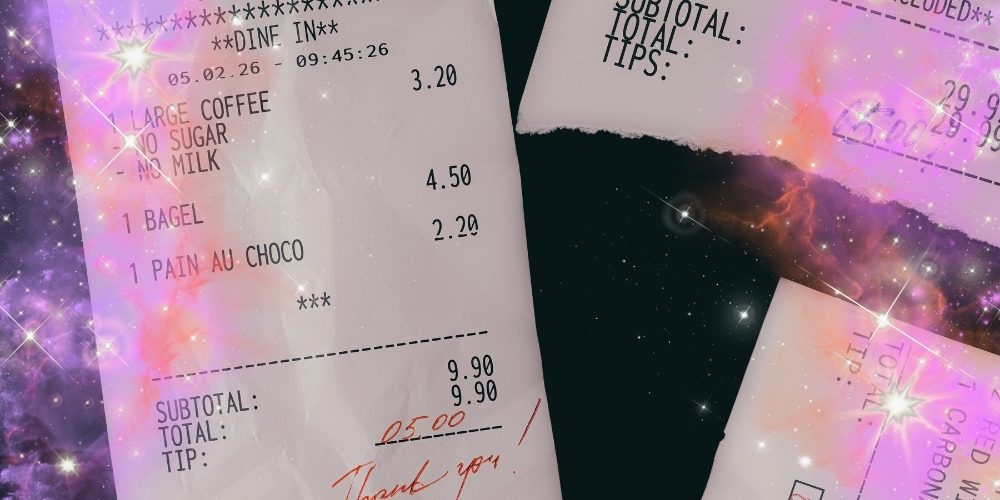
“Money Trees” surprised us in so many ways—namely, how it manages to convey so much tension and humor in so little space. We were thrilled to chat with writer Marnetta Singleton about how this hybrid piece came to life. Read her work, and then enjoy our conversation.
Rebecca Paredes: You submitted “Money Trees” for our Cost of Living challenge, which asked writers to explore debt and the perpetual cycle of finding ways to afford to live. How did that prompt inform this story?
Marnetta Singleton: When I started thinking about a modern way to explore the cost of living, the phone felt like the most natural place to begin. We receive our bills, receipts, payment confirmations, overdraft warnings, and those dreaded “payment didn’t go through” messages through our phones.
But the more I thought about it, the more I realized that our phones don’t only reveal our financial situations. They reveal our personal situations, too. They tell on our relationships, our health, our movements, our interests, and sometimes, things we would never willingly explain to another person. A phone can become a passive storyteller of your life.
I wanted readers to experience the emotional rhythm of those notifications firsthand. There is the panic of seeing that a payment didn’t go through or that your account has been overdrawn, followed by that small burst of joy when money finally comes in. Then, almost immediately, that money already has somewhere else to go. Instead of watching the protagonist’s financial situation from the outside, the reader is placed inside a simulated version of it.
Money also becomes a form of communication in the story. Through the Cash App payments and the notes attached to them, we begin to understand her relationships, her obligations, and the power dynamics between her and the people around her. Entire conversations are happening through money.
The prompt ultimately made me question what it actually costs to live. The protagonist isn’t only paying financially. She is paying mentally, emotionally, physically, and spiritually. Sometimes the cost of living is everything you have to put yourself through just to keep going.
RP: We were universally obsessed with how this narrative unravels across phone notifications, and I loved just how much insight we get into the protagonist’s life through these snippets. There are so many different forms of communication in this piece: texts and phone calls, but also messages in the notes of Cash App payments. At the same time, we physically move through the story with notifications from Maps and the Ring camera. The end result is way more effective than if we had solely read a series of text message notifications, for instance. On a craft level, how did you approach weaving together these different types of notifications, such as group texts and Pinterest, or Cash App and Boost?
MS: There are a lot of nosy people in this world, including me. There is a voyeuristic thrill in being allowed into something so private. It almost feels like going through someone’s mail, which is illegal, or snooping through someone’s room.
I was inspired by epistolary storytelling, where stories are told through letters or found documents, as well as screenlife stories and fiction told through text message threads. In many screenlife stories, we actively watch the protagonist interact with the technology. We see them typing, clicking, opening apps, or moving from one screen to another.
In “Money Trees,” we never directly watch the protagonist use her phone. We only see the notifications created by her actions and by the things happening around her. The phone is passively telling on her.
I wanted readers to play detective and put the puzzle together themselves. I carefully threaded the notifications together so that each one performed a different job. Maps creates physical movement. The Ring notification introduces danger and surveillance. Cash App reveals both financial circumstances and relationships, allowing money itself to function like dialogue. Duolingo, Pinterest, music, job notifications, subscriptions, and the other alerts reveal her interests, ambitions, personality, and the kind of life she is trying to create.
I wanted to give readers just enough information to build a complete picture of her without taking away the work of their imagination. I think the reader’s imagination is one of the most powerful parts of storytelling. The piece works more like a map than a guided tour. You have to pay attention and make connections because simply scanning the notifications won’t reveal the full story.
My attention span also played a role. Mine isn’t always the greatest, so I’m naturally drawn to storytelling that moves quickly and gets directly to the point. Notifications allowed me to create something fast-paced and fragmented without losing emotional depth.
They have also become a shared visual language for smartphone users, especially people who use iPhones. Our brains already understand the shape and meaning of an overdraft warning, a Cash App payment, a missed call, or a Ring notification almost instantly. I didn’t have to stop and explain what every alert meant because readers already encounter this language in their everyday lives.
The idea also came from a familiar and slightly embarrassing experience. You can be showing someone a completely innocent picture on your phone when a notification suddenly pops up and reveals something you never intended for them to know. That made me wonder how much of someone’s life could be revealed through those accidental little fragments.
RP: You mentioned that this piece can be read either way—top-to-bottom or bottom-to-top. I initially read this top-down, but reading it from bottom-to-top (so, chronologically) makes the time gap between the Ring notification and the final Boost notification so much more unsettling (and, of course, the fact that the “Money Trees” track is paused, so we have to wonder where the protagonist has gone). Safety is one of the central tensions in this piece—the protagonist must sacrifice safety for the cost of living—and, in my reading, we’re piecing a life together from these notifications as though we’ve found the phone, but not the person. All that to say: can you talk a bit more about how safety and security functions in this piece?
MS: For me, it all boils down to this: the protagonist sacrifices her safety to meet the cost of living, but ultimately, the cost of living may cost her her life.
I also wanted to tap into that almost universal fear of receiving a Ring notification at an odd hour. A notification saying someone is at your door or near your window might feel harmless at 2 in the afternoon. That exact same notification at 2 or 3 in the morning becomes terrifying. It tells you that someone is there, but it can’t tell you who they are, what they want, or whether you’re actually safe.
That was important because Ring cameras, Maps, and phones are all supposed to give us some sense of security. They can track where we are, record someone approaching our home, and preserve evidence that something happened. But they can’t always prevent the danger. The technology can help tell the protagonist’s story after something goes wrong, but it can’t protect her while it is happening.
The two reading directions also change how that danger is experienced. Reading from top to bottom works almost like a mystery. You begin closer to the aftermath and have to figure out what happened to this woman. Reading from bottom to top, chronologically, feels more like a thriller because you follow her through the night and watch the danger gradually build toward the implied ending.
I love that the exact same words can create two slightly different genres simply by changing the order in which they are read. One direction makes you ask, “What the hell is going on?” The other makes you experience what happened.
I especially love the final Boost notification because it doesn’t only tell us that her phone service has been suspended. The phone has served as our narrator throughout the story, and now it can no longer continue telling us what happened. The phone remains, but the woman who owned it may not.
RP: Is there anything else you’d like to share about this piece, or anything you’re working on now?
MS: This piece was incredibly fun to write, although my back may never recover from bending over my desk with a ruler held against my computer screen to make sure every notification lined up and looked pleasing to the eye.
The visual precision became part of the storytelling process, and I really enjoyed creating something that could be experienced as both a story and a visual object.
I’m currently working on my first novel, Bogus, a horror story centered on Black boyhood, friendship, survival, humor, violence, and the supernatural.
Thank you again for this opportunity and for the care you and the editorial team have shown “Money Trees.” I’m incredibly excited to see it published.