


What Is the Volta? How to Turn a Poem on Its Head

Have you ever finished reading a poem and thought to yourself, “How did I end up here?!” The poem starts one way: say, the speaker is walking around their neighborhood. Then, suddenly, they’re walking around the top of the Matterhorn talking to mountain goats. One of the possible answers is that the poet employed a volta. 

If you have ever wanted to illustrate a theme by juxtaposing it against something else, you should experiment with the volta. In this article, we will discuss what it is, how it’s typically used, and how to apply it to your own writing.

What is the volta?

The volta is the point in a poem where the direction shifts. In fact, “volta” is the Italian word for turn. You have likely come across turns in poems before, like shifts in time, in which the narrator is speaking to the past or into the future. Another common type of turn is a tonal one, where the speaker outlines all the worries of the day, only to end in defiance, declaring that those same worries will not be their downfall.

Historically, the turn is found in a sonnet, a poetic form dating back to the thirteenth century. Primarily, there are two forms of the sonnet: Petrarchan or Italian, and the English or Shakespearean sonnet. Both consist of fourteen lines and a strict rhyme scheme. However, the structure—and, therefore, the turn—comes at different times for each. 

In the Shakespearean sonnet, the turn occurs near the end with a couplet or the last two lines. 

The Italian structure is made of the first eight lines, known as the octave, followed by the next six lines, known as the sestet. The turn is nestled right in between the two halves.

Since there is a cleaner distinction between the halves in the Italian form, we will focus on that one to understand what the volta is doing.

Understanding the structure of the volta

When you hear words like “shift” or “turn,” you might feel compelled to write something shocking to make the volta effective. However, the secret to a good turn lies in the octave. 

The deeper you build the stasis of the poem, the more the volta has more to turn against. After that, the last lines, or the sestet, can then settle the turn and explain where the new direction is taking us.

For example, take a moment to read Claude McKay’s poem “To Winter.” 

Notice how the first eight lines make it sound like the narrator is welcoming spring. We get words like “sweetness,” “gaily,” “boisterously,” and “gladder.” Then, we come to the turn:

“I read these pregnant signs, know what they mean:
I know thou art making ready to go.”

With the use of “pregnant,” you can feel the cliffhanger at the end of that line, which then is followed by the narrator acknowledging winter is leaving them. You can feel their disappointment.

The sestet then further explains the new direction, that the narrator fled a land where it was always warm, looking for the cold to ease the flames of their distress.

The volta’s application to modern writing

“Make it new” is a quote attributed to Ezra Pound, and it calls for writers to eschew the outdated traditions of the past to forge their own way. Modern interpretations of the sonnet are having a moment (think Frank: Sonnets by Diane Seuss). How can something taken from an older prescriptive structure be applied to modern writing?

The easiest thing to do is forget the line requirement and rhyming scheme. You can be as succinct or expansive as you like. You can rhyme if you choose to, and if you want to employ slant rhymes, go for it. You can still use a turn in your poems. 

However, without the predictability of the structure like an octave and a sestet, you need to remember what the structure was doing. The beginning of the poem before the turn needs to set the scene, building something to turn against. You won’t be relying on the predictability of the sonnet, where you start in one place and know that you will shift and end up somewhere else. The transition needs to seem natural, while still surprising the reader. That’s the art involved. 

Think of it like a murder mystery movie, where all of the suspects are huddled around the detective while they finish their monologue—only to find out the murderer is someone we’ve never seen before and that it happened off-screen. That would feel like a cheat. The fun is showing how the culprit—or, in our case, the turn—was in front of them the whole time.

For an example of this, let’s take a look at Ada Limon’s “The Conditional.”  

Upon first reading, there is a flow to the piece, underscored by the repetition of the word “Say.”  There isn’t a defined break where the turn happens. It simply reads as a natural progression of ideas. But can you spot where the turn is?

The turn occurs in the line, “Say we never meet her. Never him.”

The first few lines are wide in scope: celestial galaxies and the animal kingdom. However, the speaker narrows their scope and shifts the focus from the expansive to the intimate. Instead of the speaker asking what if all these things happen in a far-off place, they speak of not meeting a specific person.

Why did your first reading seem like a natural progression? The repetition of “Say” in the line “Say we never meet her. Never him” mirrors the same device used in the first few lines. In addition, later after the turn, Limon includes lines like “watching the sky burn,” which reaches back to some of the first lines.

The creative voice in your head may be thinking of previous drafts you can try this on, or brand-new poems where you want to shift your reader’s perception. In any case, I hope it gets your pen moving, or your fingers typing.

For more craft tips, learn how to build a writing community, and subscribe to our newsletter for free resources every month.

Light Grows Teeth: An Interview With Barbara A. Thomas

“The Body Remembers” is about the cyclical nature of chronic illness, and we were drawn to both the structure and immensely poetic descriptions of how symptoms manifest in the body. We’re pleased to speak with Barbara A. Thomas about the craft of this piece—read it first, and then check out our conversation.

Rebecca Paredes: You submitted “The Body Remembers” for our Bad Medicine challenge. That theme asked for writing about health, illness, and the gap between the care we need and what we can access. How did that prompt inform this story?

Barbara A. Thomas: “Bad Medicine” named something I live with: the gap between the care I need and the care I can get. With Cyclical Vomiting Syndrome (CVS), the illness itself is predictable. The attacks follow the same pattern every time. What isn’t predictable is whether the people treating me will recognize that pattern. I can walk into the same ER twice in 48 hours and be asked the same questions about marijuana, given the same drug I’ve told them doesn’t work, and made to wait hours for the one medication that does.

The prompt gave me a reason to write about that second illness, the institutional one. I structured the story around the four clinical phases of CVS, then let the hospital repeat its own cycle of forgetting and disbelief inside them. I also wanted to show the performance of credibility: the printed records, the sweatshirt, the careful speech, all assembled so my pain would be believed. That effort is part of the cost of care, and it rarely shows up in the chart.

RP: This piece is separated by different stages of medical conditions: inter-episodic, prodrome, emetic, and recovery. I loved this choice because it so clearly delineates the narrator’s experience of chronic illness, and even if the reader isn’t familiar with those terms, they have such a clear sense of what those terms feel like through the narrator’s experience. Were these headings always in this story, or did you find them in revision?

BT: The headings were there from the start. CVS is defined by its phases, and they’re the one reliable structure the illness offers, so I built the story on them. I didn’t want the reader to need the terminology. The goal was for the experience to teach it, so that by the time you reach “emetic,” you already feel what the word means.

The decision I’d point to is the order. Clinically, the cycle is usually described starting with the prodrome and ending with the symptom-free interval. I opened with the inter-episodic phase instead, so the story begins in a garden and a guitar chord, in the “healthy” weeks, and the dread is already there. Then it ends on recovery that doesn’t feel like relief, just a pause before the next loop. That ordering was meant to show that, for me, the good weeks are never fully good.

RP: One of the things that stood out to me about this piece is how viscerally, yet poetically, pain is described: “The light through the blinds grows teeth. Sound grows teeth. I lie on the bathroom floor with my cheek against the tile because the cold is the only mercy available to me, and I count—not minutes, those are too small a unit—I count hours, because hours are what this phase is made of.” This is just one of the many moments in this piece that floored me, really. Can you talk about how you approach writing about the body, either in this story or in your work as a whole?

BT: With the body, I try to write what the experience does to perception rather than listing symptoms. A clinical description says “photophobia.” What I live through is light turning hostile, so the sentence gives the light teeth. I look for the point where the body stops being a set of symptoms and starts reorganizing the whole world around itself.

Walter Mosley teaches in his MasterClass that studying poetry makes one a better writer. Poets train me in the precision of language, close attention to sound, and mastery of simile, metaphor, and form. They also teach me specific vernacular and subtle implication, the art of letting what’s left unsaid do the work. Reading poetry makes me ask whether a word is exact, how a sentence sounds read aloud, and what can be implied instead of explained. That discipline lets me write about pain without defaulting to cliché.

I prefer to write in a way that engages all the bodily senses, not just sight and pain. In this story, you get the cold of the tile against a cheek, the sting of bile, the smell of crushed basil in the garden, the hum of a guitar string felt in the sternum, and the hostile glare of fluorescent light. Illness isn’t experienced through one channel, so the prose shouldn’t be, either. I also lean on active verbs as much as I can. Light grows teeth, a stomach heaves, a fist closes around the abdomen. Active verbs keep the body in motion on the page, and they keep the narrator from reading as a passive victim, even when she has no control over what’s happening to her.

The passage about counting hours comes from the same instinct. Sickness distorts time, and during the emetic phase, the usual units stop working. Minutes are too small, so the narrator counts in hours, because that’s what the phase is made of. I like it when the form of a sentence enacts the experience.

I also try not to let pain be purely bleak. The cold tile is a small mercy, and noticing mercies is how someone with a chronic illness stays alive inside it. The horror is real, but so is the bargaining. A body that needs constant negotiation takes whatever comfort is offered.

RP: Is there anything else you’d like to share about this piece, or anything you’re working on now?

BT: “The Body Remembers” said what it needed to say about CVS, so I’m looking ahead, though the next story grows out of a similar question. I’m working on a short horror story about a woman on a late-night subway ride who’s offered a way out of a life that has been slowly wearing her down. Think The Matrix meets Frida Kahlo’s self-portraits: a threshold, a choice, and a question about which is scarier, the unknown or the world we’ve all agreed to call normal.

Both stories are about what we’re asked to endure and call ordinary. In “The Body Remembers,” the narrator’s body and the system treating it each keep repeating a cycle. In my new story, the cycle is a whole person’s life, and the horror is deciding whether to leave it for the unknown.

Fit to Print Shortlist

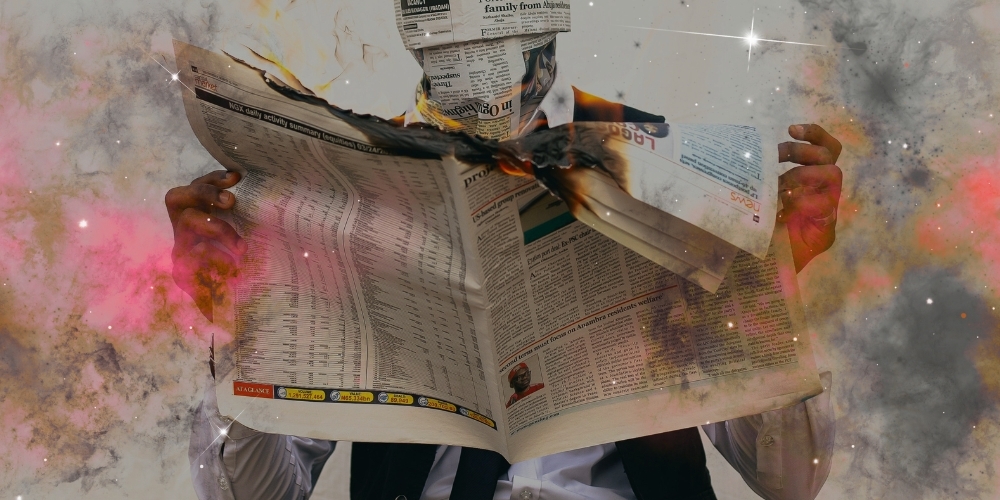
Our Fit to Print challenge asked writers to submit pieces based on recent headlines, and we were thrilled to read so many poems, stories, and essays that moved in striking and unexpected directions based on that prompt. We’re thrilled to share the titles and authors of our shortlisted pieces. We’ll announce our finalists tomorrow!

“What to Do When Your Front Door Opens Straight Into Your Living Room” by Julie Albright

“62 million” by Alison Lubar 

“More Than Grass” by Catherine Schmitt

Subscribe to our newsletter to learn about upcoming writing challenges, exclusive free calls for submissions, and more.

SEEKING: Prose and poetry about voting, elections, and resistance.

X